Not everything needs AI. We help you apply it where it actually matters.
AI Orchestrator : That Blog that sparked AI Orchestrator
Rajesh Srinivasan
4/10/2026
From Delivery Manager to AI Orchestrator
This blog became the trigger for AI Orchestrator — a broader vision across leadership transformation, AI governance, and orchestration platforms.
I am Raj, with over 25 years in delivery leadership, having played multiple roles across delivery organizations and companies.
Over the years, I have worked across Europe and the US, leading large transformation programs and building global delivery teams. My experience has evolved alongside major enterprise technology shifts — from traditional delivery to agile, from on-premise systems to the cloud, and from digital commerce to large-scale eCommerce platforms.
A few things that shaped my journey:
25+ years in delivery and transformation leadership
Worked across Europe and US with global stakeholders
Led large eCommerce transformation programs
Delivered cloud modernization initiatives
Drove agile transformation across delivery organizations
Built and scaled global delivery teams
Managed large program financials and margins
Strong stakeholder alignment and executive governance
For most of my career, delivery meant predictability.
Defined scope.
Structured milestones.
Stable teams.
Clear financials
Executive status reporting.
I was comfortable operating in that world.
I knew how to manage complexity, align stakeholders, control budgets, and deliver programs on time.
That’s what made me successful as a delivery leader.
Then things started to change.
The Program That Changed Everything
I was asked to lead a large cloud transformation program for a retail enterprise. The objective was aggressive — migrate before the holiday season, optimize cost, and accelerate delivery using AI.
I started the program the way I always had.
I built milestones.
Defined team structure
Estimated effort.
Created financial plan
Set governance.
Designed leadership reporting.
Everything looked under control. Then Subbu joined the program.
Subbu, our AI architect, started explaining how delivery would actually work:
Prompt-driven requirements
AI-assisted development
Testing agents
Migration optimization agents
Automated deployment
I remember thinking — this doesn’t fit into my plan.
My plan assumed:
Fixed scope
Fixed timelines
Stable teams
Predictable cost
Structured reporting
Subbu’s model had none of those.
When Delivery Stopped Being Deterministic
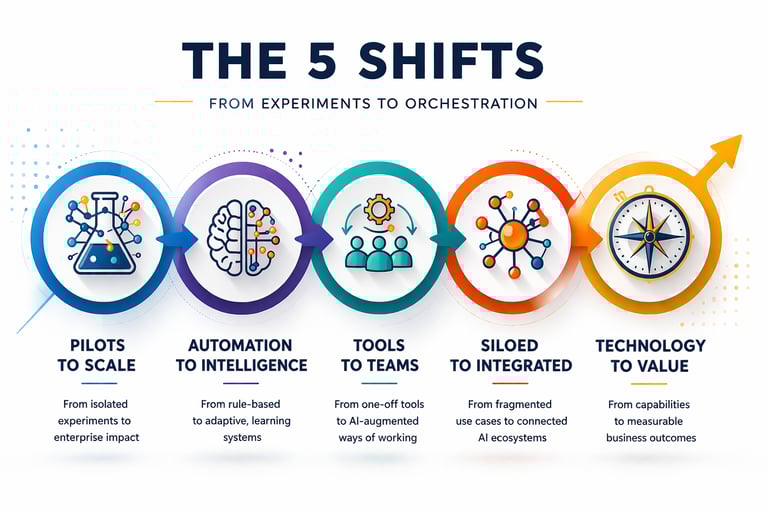
As execution began, I noticed things behaving differently.
Requirements kept evolving
AI outputs changed frequently
Migration paths optimized dynamically
Execution speed fluctuated
Token costs started appearing
Leadership asked new questions
Instead of asking:
Are we on track?
Leadership started asking:
How confident are we?
Why did the AI change the approach?
What is the cost trend?
Can we trust the outputs?
That’s when it hit me.
This cannot be managed the old way.
My First Shift — Understanding AI Delivery
I realized I was no longer managing just people.
AI agents were part of the team.
Execution was no longer deterministic — it was probabilistic.
Plans evolved continuously.
Outcomes improved with feedback loops.
My milestones stopped being fixed.
My delivery became adaptive.
The Second Shift — Rethinking Teams
Earlier, my planning started with:
How many people do I need?
Now I had to rethink the question:
What capability mix do I need?
My team now included:
Engineers
Migration agent
Testing agent
Deployment automation
AI assistants
I wasn’t managing headcount anymore.
I was designing human + AI teams.
The Third Shift — Financial Management Changed
This shift caught me by surprise.
Earlier, financial management was simple:
FTE × effort = cost
Now the financial model included:
Token consumption
Model usage cost
Agent runtime
Human oversight
Experimentation cycles
Budgets became dynamic.
Forecasts evolved weekly.
Margins needed recalibration.
I moved from FTE financial management to AI consumption financial management.
The Fourth Shift — Leadership Reporting Redefined
Leadership reporting changed dramatically.
Earlier, I reported:
Milestone status
Schedule variance
Effort burn
Risk log
Now leadership wanted:
Confidence levels
AI-driven insights
Outcome probability
Cost trend
Decision options
Static status decks stopped working.
We moved to:
AI dashboards
Real-time updates
Dynamic forecasts
Outcome-based reporting
I stopped reporting status.
I started enabling leadership decisions.
The Fifth Shift — AI First Automation Driven Delivery
As I adapted, I began using AI within my own delivery workflows.
Status updates auto-generated
Test cases AI-created
Documentation AI-assisted
Migration planning optimized
Leadership summaries generated
Governance became AI-assisted.
I spent less time tracking.
More time making decisions.
The Final Shift — Orchestration
At some point, I realized my role had fundamentally changed.
I was no longer managing tasks.
I was orchestrating:
Human teams
AI agents
Automation workflows
Model outputs
Financial consumption
Leadership reporting
Governance guardrails
I was balancing:
Speed and trust
Automation and oversight
Cost and outcomes
AI insights and judgment
That’s when I understood.
I had become an AI Orchestrator.
What Changed for Me
I stopped managing milestones — I started managing adaptive execution
I stopped planning headcount — I started designing human + AI teams
I stopped managing fixed budgets — I started managing AI consumption
I stopped creating status reports — I started enabling leadership decisions
I stopped tracking execution — I started orchestrating intelligent systems
I stopped managing delivery — I started orchestrating outcomes
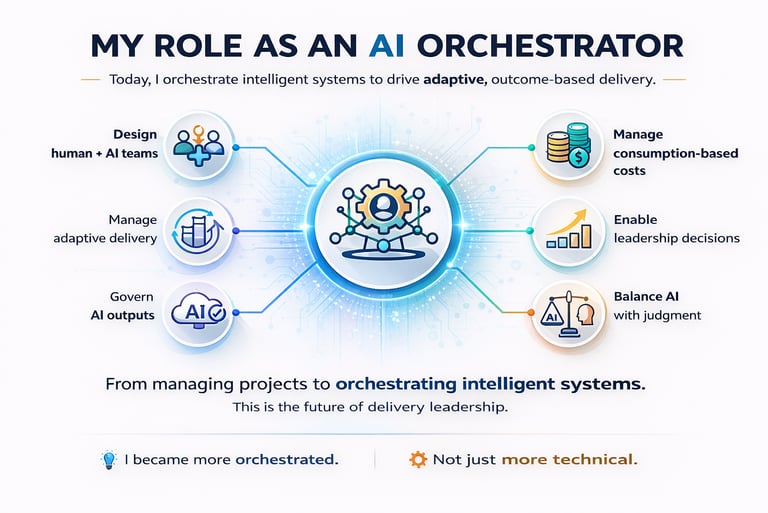
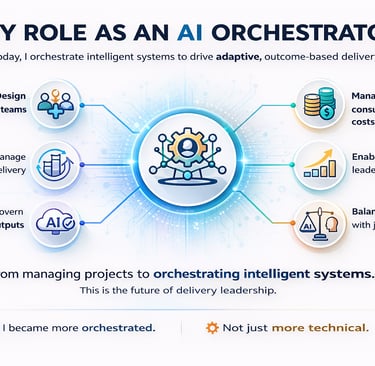
The New Role — AI Orchestrator
My role today is different.
I design human + AI teams
I manage adaptive delivery
I govern AI outputs
I manage consumption-based cost
I enable leadership decisions
I drive outcome-based reporting
I balance AI and judgment
I didn’t become more technical. I became more orchestrated.
I moved from managing projects to orchestrating intelligent systems.
And I believe this is the future of delivery leadership.
The AI Orchestrator.
Connect
Reach out for enterprise AI strategy support
Contact
+91 99400 74083
© 2026. All rights reserved.